Spanish Outposts and Rancho Era Adobes
The county’s recorded architectural history began during the Spanish and Mexican eras, when land grants established vast ranchos across the valley. Built as extensions of the coastal mission system, these outposts served as hubs for agriculture, cattle grazing, and regional trade.
One of the most notable surviving structures is the San Bernardino Asistencia in Redlands. Constructed around 1830 as a branch of Mission San Gabriel, this restored adobe complex features a traditional courtyard, tile roofs, and residential quarters that provide a rare glimpse into pre-statehood California.
Further east lies the Yucaipa Adobe. Built in 1842 by Diego Sepúlveda, it is widely regarded as the oldest surviving residential structure in San Bernardino County. Constructed from hand-formed mud bricks, the building stands as a testament to the endurance of early California ranching life before the Gold Rush altered the state’s demographic landscape.
The Pioneer Era and Railroad Dominance
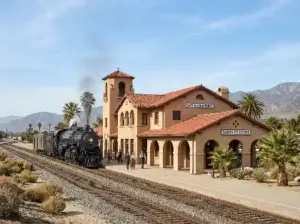
In the mid-19th century, waves of settlers passed through Cajon Pass along the Salt Lake Trail. In 1851, hundreds of Mormon pioneers descended into the valley, purchasing Rancho San Bernardino and establishing a formal city layout grid. However, it was the arrival of the transcontinental rail lines in the late 19th century that permanently cemented San Bernardino’s role as Southern California’s logistics gateway.
Standing in downtown San Bernardino, the Santa Fe Depot (built in 1918) remains a crown jewel of regional rail heritage. Designed in an ornate Mission Revival style with sweeping arcades and tiled domes, the station once welcomed thousands of travelers arriving on steam trains. Today, it houses the San Bernardino History and Railroad Museum, preserving vintage velocipedes, antique station clocks, and early rail artifacts.
Key Historical Eras Represented in the County:
- Mission & Rancho Period (1810s–1840s): Agricultural outposts, irrigation zanjas, and adobe homesteads.
- Pioneer & Mining Boom (1850s–1880s): Wagon trails, mountain toll roads, and desert boomtowns.
- Railroad Expansion & Citrus Era (1880s–1930s): Grand depots, packing houses, and civic architecture.
- The Automobile Age (1920s–1960s): Mid-century Route 66 diners, roadside neon, and drive-ins.
Desert Mining and Western Ghost Towns
Beyond the mountains lies the high desert, where 19th-century discoveries of silver, borax, and gold sparked chaotic mining rushes. The harsh desert environment preserved many of these outposts in remarkable detail.
Perched in the Calico Mountains, Calico Ghost Town was established in 1881 following a massive silver strike. During its peak, the town produced tens of millions of dollars in silver ore across over 500 mines. Restored as a San Bernardino County Regional Park, Calico features original wooden boardwalks, mine shafts, and historic buildings that bring the wild 1880s boomtown atmosphere back to life.
Further out in the Mojave Desert sits the Kelso Depot. Built in 1924 by Union Pacific, this elegant Spanish-style station provided a lush oasis for passenger trains traveling between Los Angeles and Salt Lake City. Restored as a visitor center within Mojave National Preserve, it highlights the engineering feats required to cross the desert expanse.
Icons of the Mother Road
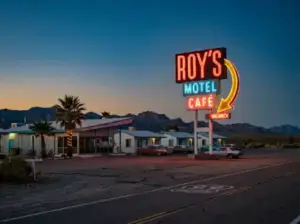
San Bernardino County contains one of the longest continuous stretches of Route 66 in California. As post-war automobile culture exploded, roadside landmarks popped up across the desert corridors and urban thoroughfares.
From the historic Wigwam Motel in San Bernardino—with its iconic concrete teepees built in 1949—to Roy’s Motel and Café standing isolated in Amboy, these architectural novelties reflect an era when the open road represented pure freedom. Preserving these highway landmarks ensures that California’s motoring culture remains accessible to future generations.
Planning Your Historical Self-Guided Tour
Whether visiting the valley adobes or driving out to high-desert historical sites, touring San Bernardino County’s historic places requires a little planning due to the vast distances between destinations:
- Group Sites by Geography: Tackle valley sites like the Yucaipa Adobe and Asistencia on one trip, while reserving desert sites like Calico and Kelso Depot for a dedicated highway trip.
- Check Operating Hours: Many county museum branches and historical sites operate on specific seasonal schedules or weekend hours.
- Respect Preservation Boundaries: Historic adobe walls and desert ghost towns are fragile. Always stay on marked pathways and refrain from disturbing historic structures.
San Bernardino County’s historical landmarks tell the story of a region built on movement, ambition, and adaptation. Exploring these sites gives context to the modern roads and cities we travel today.